Hey, it's Dr. Bailey
You know that feeling when everything on your plate seems equally urgent and completely different from the last thing you dealt with? One moment you're navigating a restructure, the next you're coaching someone through a conflict they've been sitting on for months.
I have been thinking about this a lot lately. That tension is not a sign you're doing it wrong. It is a sign you are leading in conditions that demand more precision than most of us were ever taught to bring. As you read, I want you to ask yourself: am I responding to what is actually in front of me, or am I applying last quarter's playbook to this quarter's reality? Hit reply and tell me what comes up. |
In this week's edition: What's Coming Up at SkillsCamp You Can't Lead What You Can't Name When Everything Feels Like Your Problem
The 64% Nobody's Talking About
|
|
|
|
What's Coming Up at SkillsCamp |
COMING SOON: Leadership Intensive: Designing for Resilience - A half-day workshop for people leaders navigating rapid change. Register your interest
ONGOING: SkillsCamp Learning Studio - Soft skills programming for teams, built to be reinforced in practice and not just checked off in a day. Learn more |
|
|
|
You Can't Lead What You Can't Name |
I keep hearing VUCA thrown around like it means one thing. But I want to push back on that, because volatility, uncertainty, complexity, and ambiguity are genuinely different conditions that call for different responses.
Volatility is when change is rapid but predictable in nature. You know the kind of disruption, you just don't know how fast it is coming. Uncertainty is when cause and effect are knowable, but you don't have the information yet. Complexity is when there are so many interconnected variables that no single answer exists. And ambiguity is when you genuinely don't know what you're dealing with. The rules haven't been written yet.
In real leadership situations, they are almost never clean or separate. Most of us are sitting in some combination of all four at once, which is exactly why this work is so hard. But I believe having language for each one still changes how you lead. You cannot respond well to something you cannot name. |
- Precision is not pedantic.
For people leaders, naming the specific condition you are in is one of the most practical tools we have. I come back to this constantly. It changes what you reach for next. - Start by naming what is in front of you.
Is this volatile, uncertain, complex, or ambiguous? The answer changes your response. Volatile calls for speed. Uncertainty calls for information-gathering. Complexity calls for collaboration. Ambiguity calls for experimentation. You do not need to solve all four at once. - Most of us are navigating all four.
And that is OK. The goal is not to sort everything into a clean category. It is to slow down long enough to ask: what kind of challenge is this, really? That one question changes the conversation.
|
If you are navigating this kind of tension right now, I want you to know that precision is a form of self-compassion. You do not have to carry all of it. You just have to name what is actually in front of you and respond to that.
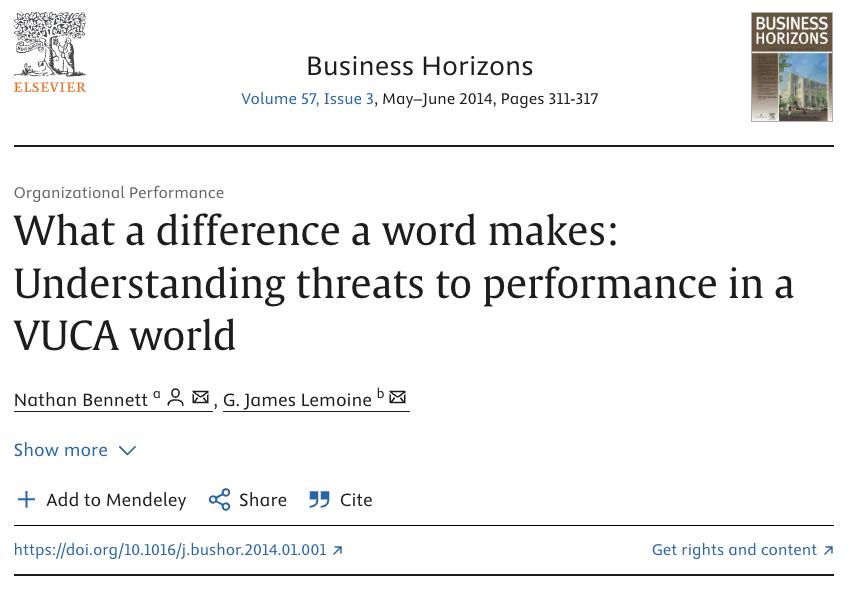
Read the original VUCA research by Bennett & Lemoine → |
|
|
|
When Everything Feels Like Your Problem |
A reader writes: "One thing I struggle with in my role is juggling multiple agendas and needs as well as the guilt of not being able to meet everyone's needs. Especially when I can see how systems are problematic but I also have to work within those systems." I feel this one deeply. And I think most of us do. |
- The guilt is a signal, not a flaw.
If you feel guilty about not meeting every need, it is because you actually care. That is not the problem. The problem is that caring without boundaries becomes unsustainable. - You are not responsible for fixing the system alone.
Seeing what is broken does not mean it is yours to repair single-handedly. Your job is to lead well within the constraints you have while naming what needs to change. Those are two different things. -
Prioritize honesty over heroics.
You will not meet every need. But people will remember whether you were straight with them about what you could and could not do. That honesty builds more trust than trying to be everything.
|
If you are navigating this tension right now, know that you are not alone. And the fact that you are asking the question tells me you are already leading better than you think.
Have a question for me? Hit reply → |
|
|
|
The 64% Nobody's Talking About |
Every year Gallup releases the State of the Global Workplace report. I always read it cover to cover. The 2026 edition surveyed over 200,000 people across more than 160 countries. For a second consecutive year, engagement dropped to 20%, down from its peak of 23% in 2023. But when I read the headline this year, I thought: engagement dropping is not the story. |
- 16% are actively disengaged.
Not just unhappy, but actively spreading that unhappiness. Research shows they can undo the work of multiple engaged employees around them. That is 1 in 6 people. - 64% are simply "not engaged."
Not miserable. Not causing problems. Just present. Doing enough. Going through the motions. Physically there, psychologically somewhere else entirely. - Gallup calls them "not engaged."
I call them people who have not been cared for or given a reason to care yet.
|
That reframe changes everything for me. If the majority of working people are simply waiting for someone to show up for them, that is not a motivation problem. That is a leadership problem. And it is one we can actually do something about.
Read the full Gallup 2026 report → |
|
|
|
Thanks for reading!
Don't want to receive these emails? There's an unsubscribe button at the bottom. |
Copyright Skills Camp 2026 20 Iannuzzi Street, TH9, Toronto, ON, M5V0A2 |
|
|
|
|